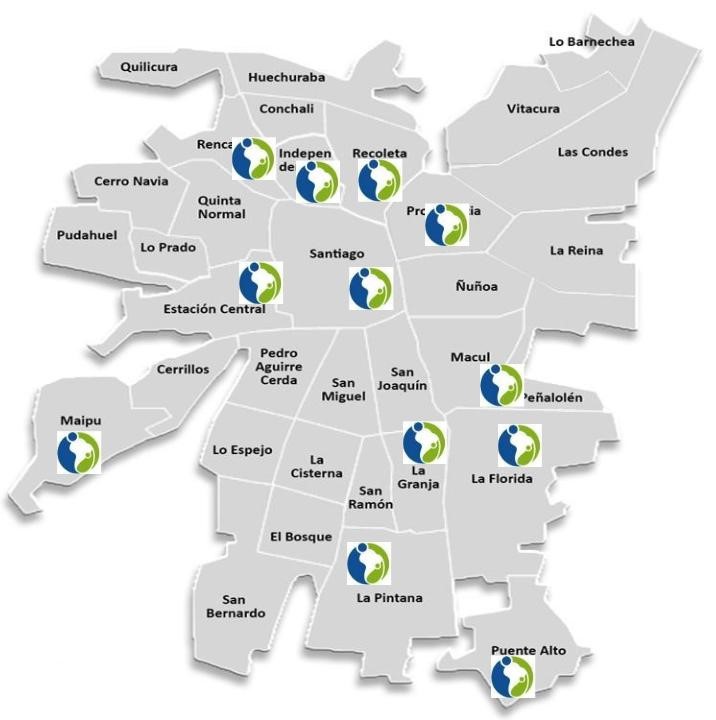
Where We Work


Starting with a group of volunteers in La Florida’s Hogar Esperanza in 2004, VE has continued to seek small foundations with similar goals to serve as many children as possible through our service partner network. These orphanages, community centers, and schools work towards continuity, love and a better future for their children.

The orphanages range from 12 to 75 children who have been removed from their homes due to abuse or neglect and placed in the home, usually by the Chilean government. The community centers serve around 100 children with varying ages and schedules, coming to the centers to receive after-school support, homework help, and emotional guidance. VE also works with one school that serves children with special needs, and one daycare center for children who live in one of Santiago’s “campamentos” or shanty towns.

Centro Comunitario Los Navíos:

Since 1998, Community Center Los Navíos has focused its efforts on the continuing problem of child abuse in its various manifestations, including neglect and physical, psychological, and sexual abuse. The Center offers an after-school program, workshops, home visits, academic help, and other assistance based on individual need. This assistance consists of everything from distribution food and clothing donations, medical clinics, and securing police intervention for protection in domestic abuse situations. The center provides homework help, psychological treatment, a listening ear, security, attention, and love on a daily basis.

Los Navios has been an important force in the community since its inception; an open, welcoming place for social interaction and support. It is a well-used and respected resource for the entire community. One need only take a walk in the neighborhood with a staff member (known as tías and tíos) to see the genuine bond those at the Center have forged with the community. They are greeted with warm affection and respond to the stories they are told every day by with empathy and action. Permanent contact with the community has allowed the staff members to educate, intervene, and treat the various factors associated with child abuse.

The Community Center serves 100 children, ages 2-20, and their families. Most of the children live in the neighborhoods of  the La Florida comuna of Santiago. The socioeconomic condition in the area is one of social exclusion, high poverty, illiteracy and low academic achievement, domestic violence, and students at a high risk of academic desertion.

Club Domingo Savio:

“My Club” Domingo Savio was founded in 1979 as an hogar (children’s home) but in the past four years has transformed into an after school center. The club is located in La Granja, one of the poorest areas in Santiago. The club provides a long-term and family-like atmosphere for children without stable living situations. It focuses on programs that develop the abilities of the kids in high risk situations while continuing to have them live with their families whenever possible. The club runs each day for about 45 children between the ages of 5 to 14. There are workshops such as theatre, art, English, carpentry and a time everyday for homework or extra practice in subjects where the children need help. Underpinning the entire curriculum is a set of values that stress the importance of self – initiative, tolerance, and respect for oneself and for others. Many of the kids’ academic performance improve dramatically, and more than anything, the children receive a positive sense of hope about their futures.

Read about a day in the life at Club Domingo Savio.

Colegio Anakena:

Colegio Anakena was founded in 1987 as a school for children with speech and language problems. Through the years, the school has expanded to serve children with emotional issues, autism, delayed development and learning disabilities. Located in the La Florida section of Santiago, the school serves more than 150 students between the ages of 3 and 16 daily. They receive specialized instruction for hearing and speech problems, behavioral problems, hyperactivity disorders, autism and other disabilities. The students are grouped into classes according to age, educational level and type of disability, so that the tias (teachers) can most effectively use their pedalogical strategies, adaptions, and innovations to optimize their quality of life and facilitate social inclusion.

Beyond classroom instruction, Anakena provides a number of talleres or workshops, focusing on building computer skills, motor skills and social interaction.

Read about a day in the life at Colegio Anakena.

Fundación La Promesa:

Fundación La Promesa is comprised of two homes which are divided by gender. Both homes have about 15 children, roughly between the ages of 4 and 18. The children have arrived to the home through the family court system. Children in La Promesa have experienced serious mental illness within their family, neglect, physical abuse and/or sexual abuse.

La Promesa is dedicated to providing a healthy, family-style environment, doing all of the things that any mother or father would do for their children. La Promesa was founded in 1985.

Visit the official website of Fundación La Promesa.

Fundación Pléyades:

Fundación Pléyades is a non-profit organization that works with young children in situations of social risk. The main objective is to reintroduce these children to a family-like atmosphere where they feel protected and loved. The home receives children who have seen their basic rights violated, whether through abuse, abandonment or neglect, and need a place to accept them while their families try to recreate an environment of love and security to which they may one day return.

The home is equipped to receive no more than 15 children between two and thirteen years old, as the home seeks to maintain a familial atmosphere. The children are cared for by an in-house team that counts on the support of volunteers. Psychological intervention is overseen by a psychologist and a social worker, who guide the suitable physical, psychological and social development of the children, in addition to promoting change in their families and home environment.

Pléyades also runs the program Cable a Tierra which works with children in Santiago's shanty towns who spend their time on the streets.

Fundación Pléyades depends on the work of positive volunteers, willing to connect with the children and motivated by the desire to create change in their lives. In the home, volunteers work every day of the week, accompanying, teaching and supporting the children who live there. Through “Cable a Tierra”, the volunteers gather every Saturday afternoon to support educational and recreational activities with the kids.

Visit the official website of Fundación Pleyedes and read about a day in the life at Fundación Pléyades.

Hogar Esperanza - Casa de Lactantes:

Formed in 2001, Hogar Esperanza's second home, the Casa de Lactantes currently serves 19 children between the ages of 0 and 9.  however the home will expand to accommodate  24 pre-schoolers. The home works to prepare the infants for adoption and there are many comings and goings in the home, this results in a fast pace where the volunteers and tías (nannies) work in a fun but constantly changing environment.

Visit the official website of Hogar Esperanza and read about a day in the life at Hogar Esperanza.

El Jardín:

Found within a squatter's camp, El Jardín de Peñalolén is a kindergarten that works with 40 pre-schoolers who live within the toma. Our volunteers have supported the work of the tías with educational and recreative talleres with the pre-schoolers.

Read about a day in the life in El Jardín.

Hogar San Francisco de Regis: 

Like Entre Todas and Aldea, San Francisco de Regis works to restore the rights of girls and teenagers who have suffered neglect or abuse. The home houses 30 girls from ages 4 to 19. Volunteers provide homework help, fun activities and talleres, emotional support and help with everyday tasks to support the work of the tías. Hogar San Francisco is primarily a religious organisation and whilst it is run by a convent and promotes a Catholic tradition, the home accepts volunteers from wide and varying backgrounds.

Read about a day in the life at Hogar San Francisco de Regis.